Utilities, Power & Life-Support
How the Station makes its water, conditions it for fresh, brackish, and saltwater life, keeps it clean and oxygenated, holds it at temperature, and guarantees the power to do all of it without ever letting a cold-water system go dark or a cascade collapse.
Plant Telemetry
Water Production — RO & Seawater
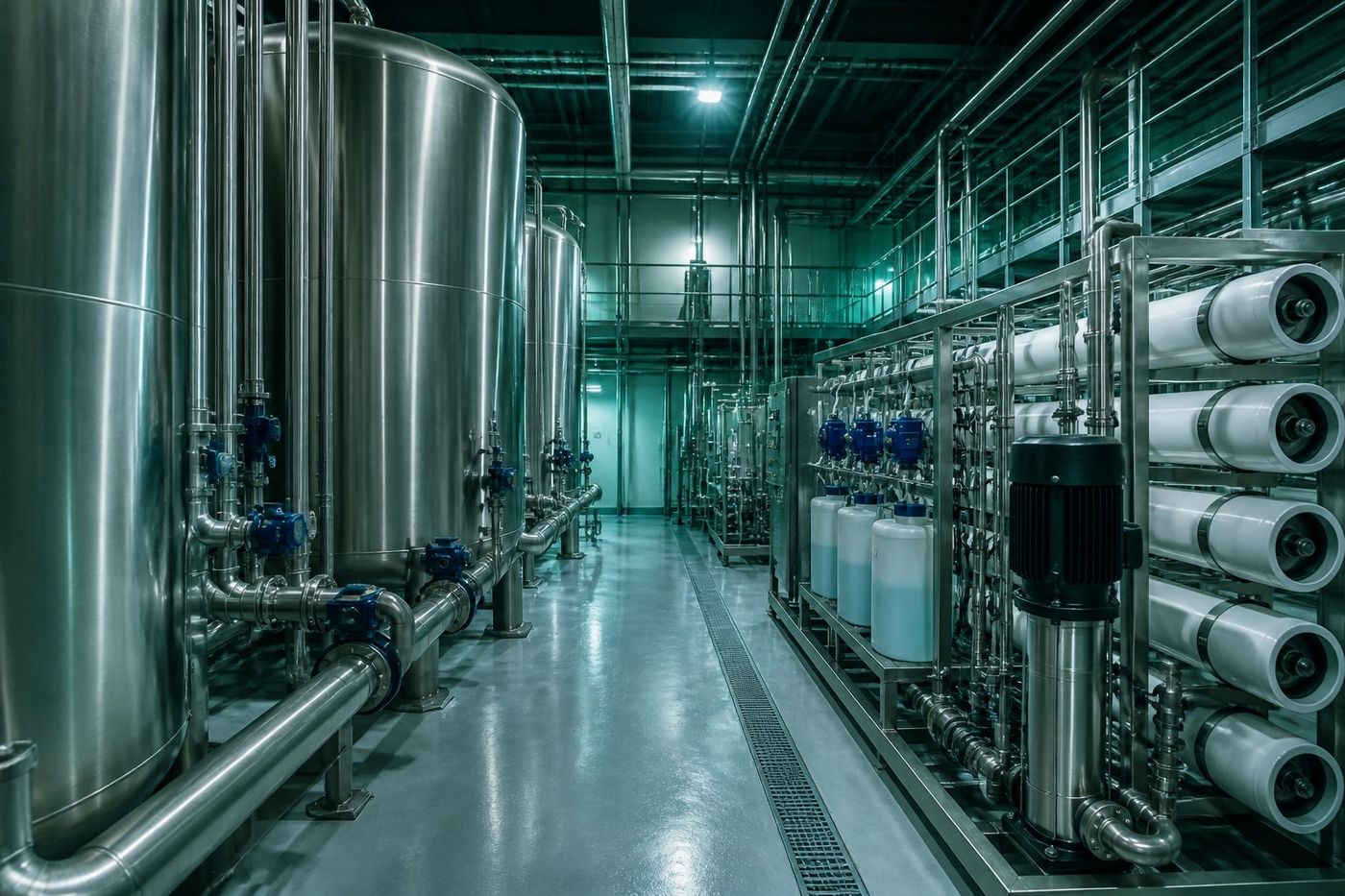
Every drop of system water originates in Water Prep & Reservoirs. Reverse-osmosis strips the incoming municipal supply to near-zero dissolved solids; that pure water is then remineralized and salted to each system's recipe, or drawn raw for soft blackwater systems. Saltwater systems are made up from RO + reef salt, with a filtered natural-seawater intake from the dock as a backstop for the Reef Conservatory and Abyssal Holding.
| Source / Stage | Type | Capacity | Output Quality | Role | Status |
|---|---|---|---|---|---|
| RO Train A | 3-stage RO + carbon pre-filter | 48 m³/day | < 10 µS·cm⁻¹ | Primary pure-water | ● Online |
| RO Train B | 3-stage RO + carbon pre-filter | 48 m³/day | < 10 µS·cm⁻¹ | Primary pure-water | ● Online |
| RO Train C | 3-stage RO (standby) | 48 m³/day | < 10 µS·cm⁻¹ | N+1 standby | ◐ Standby |
| Seawater Intake | Filtered + UV dock intake | 40 m³/h | SG 1.024–1.026 | Reef/Abyssal make-up backstop | ● Online |
| Remineralization Skid | Dosing — GH/KH/trace | — | Per-recipe | RO → freshwater recipes | ● Online |
| Salt-Mix Skid | Auto reef-salt blending | 6 m³/batch | SG 1.005–1.026 | RO → brackish/saltwater | ● Online |
Species Mixing Reservoirs
Pure RO is useless to a living system — it must be matched to the species. The reservoir hall holds nine pre-mixed reservoirs so that every water change and top-off draws ready, aged, temperature-matched water, never raw RO. This is the buffer that gives the Station its 72-hour make-up autonomy: even with all RO trains down, husbandry continues from stored water.
| Reservoir | Blend | Volume | Target Chemistry | Serves |
|---|---|---|---|---|
| R1–R2 Rift-Hard | RO + GH/KH boost | 2 × 12 m³ | pH 8.0 · GH 12 · KH 10 | Cichlid Hall |
| R3 Community-Soft | RO + light minerals | 14 m³ | pH 7.4 · GH 8 | Livebearer Racks |
| R4 Blackwater | RO + tannin, low mineral | 8 m³ | pH 6.4 · GH 3 | Aquatic Flora · soft-water lots |
| R5–R6 Reef Salt | RO + reef salt | 2 × 16 m³ | SG 1.026 · pH 8.2 · KH 9 | Reef Conservatory |
| R7 Brackish | RO + partial salt | 10 m³ | SG 1.008 | Invertebrate Room |
| R8 Cold-Marine | RO + reef salt, chilled | 14 m³ | SG 1.025 · 10 °C | Abyssal Holding |
| R9 Quarantine Neutral | RO + adjustable | 10 m³ | Lot-specific | Quarantine & Triage |
Life-Support Systems (LSS)
Each husbandry zone runs an independent life-support loop. The job of LSS is to remove what the animals produce (ammonia, organics, CO₂, particulates), add what they need (oxygen, the right temperature), and kill what would harm them (pathogens), without ever cross-connecting two systems. Setpoints are watched by the AquaLink mesh; Facilities owns the plant that makes them achievable.
| LSS Component | Function | Where | Spec / Capacity | Redundancy |
|---|---|---|---|---|
| Mechanical filtration | Particulate removal | All systems | Drum filters, 60 µm | Dual on large systems |
| Biological filtration | Ammonia → nitrate | All systems | Moving-bed + media beds | Sized 150% of bioload |
| Protein skimming | Dissolved-organic removal | Salt / brackish | Venturi skimmers, 2× turnover | N+1 on Reef & Abyssal |
| UV sterilization | Free-floating pathogen kill | All systems | Sized to ≥ 90 mJ/cm² | Dual lamps per unit |
| Ozone (redox control) | Polish, clarity, pathogen | Reef · Quarantine · Abyssal | ORP-controlled, off-gas carbon | Hard ORP high-limit cut |
| Chillers | Cooling — cold-water systems | Abyssal · Reef | 6 units · N+1 | 2N on Abyssal loop |
| Heaters | Heating — tropical systems | Fresh / brackish | Titanium, dual-element | Redundant + alarm |
| Aeration / O₂ | Dissolved-oxygen maintenance | All systems | Regenerative blowers + O₂ backup | O₂ cylinder failover |
| CO₂ dosing | Planted-tank carbon & pH | Aquatic Flora | Solenoid, pH-controlled | High-limit purge interlock |
Power Generation & Redundancy
The Station runs a hybrid supply backstopped to a "no-break, no-dark" standard for life-support. On-site solar and the dock-side wave array shave demand; a dual grid feed carries base load; a genset and battery hold life-support through any outage. The Gyre Stations run fully off-grid on their own solar/wave plant.
| Source | Type | Nameplate | Role | Status |
|---|---|---|---|---|
| Utility Grid Tie | Dual 11 kV feed, separate routes | 3.5 MW | Base load & import balance | ● Both feeds live |
| Rooftop Solar | PV over hub + Conservatory roof | 1.1 MW | Daytime demand shave | ● Online |
| Dock Wave Array | Point-absorber WEC pair | 0.6 MW | Renewable shave · dock loads | ● Online |
| Emergency Genset | 1.6 MW diesel, 96 h fuel | 1.6 MW | Life-support on grid loss | ◐ Standby · tested wk |
| Battery (BESS) | LFP storage | 1.2 MW / 3.6 MWh | Ride-through & genset bridge | ● 91% SoC |
| Gyre Station Plant ×2 | Solar + wave, islanded | 120 kW each | Off-grid Gyre autonomy | ● Islanded |
Distribution is a dual-bus 11 kV ring with automatic transfer. Life-support-critical loads — Abyssal chillers and cascade fans, all skimmers/UV/biofilter pumps, security, and the AquaLink mesh — sit on a segregated Essential Bus that is never load-shed and is first to receive battery and genset power.
Backup & Autonomy
UPS / BESS
1.2 MW / 3.6 MWh LFP. Zero-break transfer for the Essential Bus; ≥ 30 min autonomy for Abyssal chill & cascade before genset cutover.
Emergency Genset
1.6 MW diesel, 96 h fuel on-site. Auto-start on bus undervoltage; carries the full Essential Bus.
72 h Reservoir
Pre-mixed make-up reservoirs sustain water changes and top-off through a total RO outage with no impact on stock.
Redundancy & Failover
| System | Topology | Single-Fault Behavior | Failover Time |
|---|---|---|---|
| Grid supply | Dual 11 kV feed, separate routes | Surviving feed carries full load | Automatic, < 200 ms |
| Essential Bus power | UPS/BESS + N+1 genset | No break on bus; genset assumes load | < 1 cycle (BESS) / ≤ 12 s (genset) |
| Abyssal chillers | 2N (A/B chill trains) | Standby train auto-starts, temp held | < 60 s |
| Abyssal cascade fans | 2N (A/B fan trains) | Standby train auto-starts, cascade held | < 2 s |
| RO production | N+1 trains + 72 h reservoir | Standby train stages / draw from reservoir | Immediate (stored water) |
| Life-support pumps | Dual pump per large system | Standby pump auto-starts on flow loss | < 15 s |
| Dissolved oxygen | Blower + O₂ cylinder backup | Auto-switch to O₂ on blower fault | < 10 s |
Plant Maintenance Schedule
Preventive maintenance for power, water, and LSS plant. The full asset register and work-order process live in AE-FAC-0040.
| Asset | Interval | Task | Owner |
|---|---|---|---|
| Emergency genset | Weekly | On-load test, fuel polish, start-time log | FAC-UTL |
| UPS / BESS | Monthly | Autonomy test, cell impedance, transfer | FAC-UTL |
| Abyssal chillers | Monthly (A/B alt.) | Standby-train run, refrigerant, temp verify | FAC-UTL + FAC-BSZ |
| Protein skimmers | Weekly | Cup clean, venturi check, draw-rate | FAC-SYS |
| UV / ozone units | Quarterly | Lamp hours, quartz clean, ORP cal | FAC-SYS |
| RO membranes | Quarterly | Flux, conductivity, CIP, pre-filter swap | FAC-UTL |
| Drum / mechanical filters | Weekly | Screen clean, motor & spray check | FAC-SYS |
| Switchgear / relays | Annual | Thermography, relay test, torque audit | FAC-UTL |