Marine Health & Veterinary
Animal-health protocols across the Breeding Station: surveillance, quarantine screening, pathogen and parasite response, water-quality-driven welfare, necropsy and diagnostics, and the veterinary role in rewilding fitness. Bound to the biosecurity zoning map and the intake quarantine SOP.
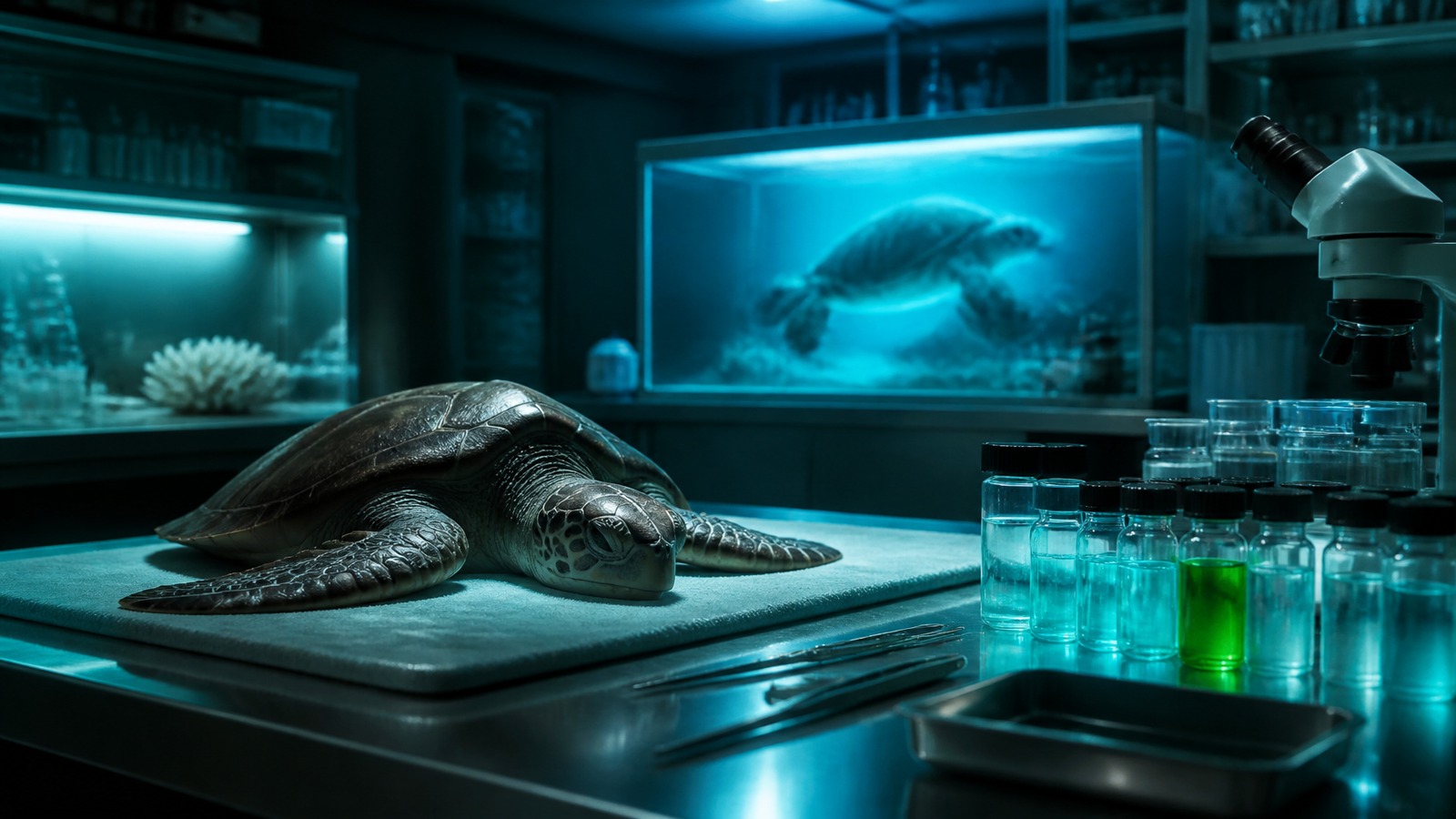
Mandate
The veterinary mandate is welfare in service of return. We do not treat to display a healthy animal; we treat to release a fit one. Every protocol — from a routine gill scrape to a full necropsy — feeds one question: is this lineage healthy enough to survive the wild, and clean enough not to carry our problems into it.
Welfare indicators
Disease surveillance
Surveillance is continuous and passive-first. The AquaLink mesh watches water quality as a leading indicator — most disease in a closed system is a welfare failure before it is an infection. NEREID flags behavioural anomalies from tank cameras (flashing, clamped fins, off-feed) and escalates clusters to the veterinary desk before a technician would notice them. Active screening — scrapes, swabs, and tissue panels — runs on a risk-weighted schedule, heaviest at intake and before any release.
Quarantine health screening
No animal enters a culture zone, and none leaves for rewilding, without clearing screening. Intake stock runs a mandatory isolation period in Quarantine & Triage under the intake quarantine SOP: external parasite exam, gill and skin scrape, and a pathogen panel sized to the species' known risks. Clearance is a veterinary signature, not the calendar.
Pathogens, parasites & response
The common adversaries across freshwater, brackish, and saltwater systems, and the standing first-line response. Treatment is always paired with a water-quality review — the pathogen is frequently the symptom, not the cause.
| Pathogen / parasite | Type | System | Signs | First-line response | Severity |
|---|---|---|---|---|---|
| Marine ich (Cryptocaryon) | Ciliate parasite | Saltwater | White spots, flashing, rapid gilling | Isolate; hyposalinity or copper in quarantine; raise hygiene | High |
| Marine velvet (Amyloodinium) | Dinoflagellate | Saltwater | Dusting, lethargy, sudden mass mortality | Immediate isolation; copper; aggressive — treat on suspicion | Critical |
| Vibriosis (Vibrio spp.) | Bacterium | Salt / brackish | Ulcers, reddening, larval die-off | Sample & culture; targeted antibiotic; correct organic load | High |
| Coral disease (tissue-loss) | Microbial complex | Reef Conservatory | Advancing lesion, tissue sloughing | Frag firebreak; isolate colony; review flow & temperature | Critical |
| Freshwater ich (Ichthyophthirius) | Ciliate parasite | Freshwater | White spots, flashing | Raise temperature; quarantine treatment; monitor cohort | Moderate |
| Columnaris (Flavobacterium) | Bacterium | Freshwater | Saddle lesions, frayed fins | Lower temperature; salt/antibacterial; reduce crowding | High |
Water-quality-driven welfare
The clinic's most-used diagnostic is the water panel. A stalled filter, a salinity drift, or an overnight oxygen sag will manifest as "disease" days before any pathogen does. Veterinary always reads station dissolved oxygen, pH, and salinity against setpoint before reaching for a treatment — because the cheapest cure is usually a water change, not a drug.
Necropsy & diagnostics
Every unexplained death is a data point we cannot afford to waste. Necropsy runs to a target turnaround so that a transmissible cause is caught before it spreads — gross exam, wet mounts, histology where warranted, and culture for suspected bacterial cases. Findings feed back into surveillance and, when a lineage is implicated, into the cryo-bank disposition record.
- Log & chill. Death recorded against the lineage; carcass preserved within the turnaround window.
- Gross exam. External and internal survey for lesions, parasites, and organ pathology.
- Wet mounts. Gill and skin scrapes under the scope for parasites and protozoa — fastest answer in the building.
- Histology & culture. Tissue and bacterial work where the gross exam is inconclusive or transmissibility is suspected.
- Disposition. Findings logged to surveillance; cohort screened; cryo and pedigree records updated.
The veterinary role in rewilding
Veterinary holds the final gate before a release. Fitness is not the absence of disease — it is the presence of wild competence: the animal feeds on wild diet, holds condition against current, and carries no pathogen load that the destination cannot already bear. A clean bill is a veterinary signature on the release order, and it is the one signature that cannot be overridden by schedule pressure.
Biosecurity tie-in
Animal health and facility biosecurity are one discipline seen from two desks. The pathogen response above is only as strong as the zoning that contains it — dedicated equipment per zone, directional workflow from clean to dirty, and footbaths and barriers between culture systems. When the quarterly biosecurity drill runs, the veterinary desk and the facilities desk run it together.
Clean-to-dirty flow
Staff and tools move one direction only — from low-risk culture zones toward quarantine, never back without decontamination.
Dedicated equipment
Nets, siphons, and containers are colour-coded per zone. Shared equipment is the most common vector — so it is not shared.
Bioindicator stock
Sentinel invertebrates react to contamination before instruments do, feeding the stress signal.