Genome & Cryo-Bank
A seed vault for the sea. The League holds frozen gametes, embryos, tissue, and sequenced genomes against the day a wild population fails — and a breathing collection of living broodstock to back them. Cryo-preserved diversity is meaningless without animals to express it; this is where the two halves meet.
Cryo-preservation
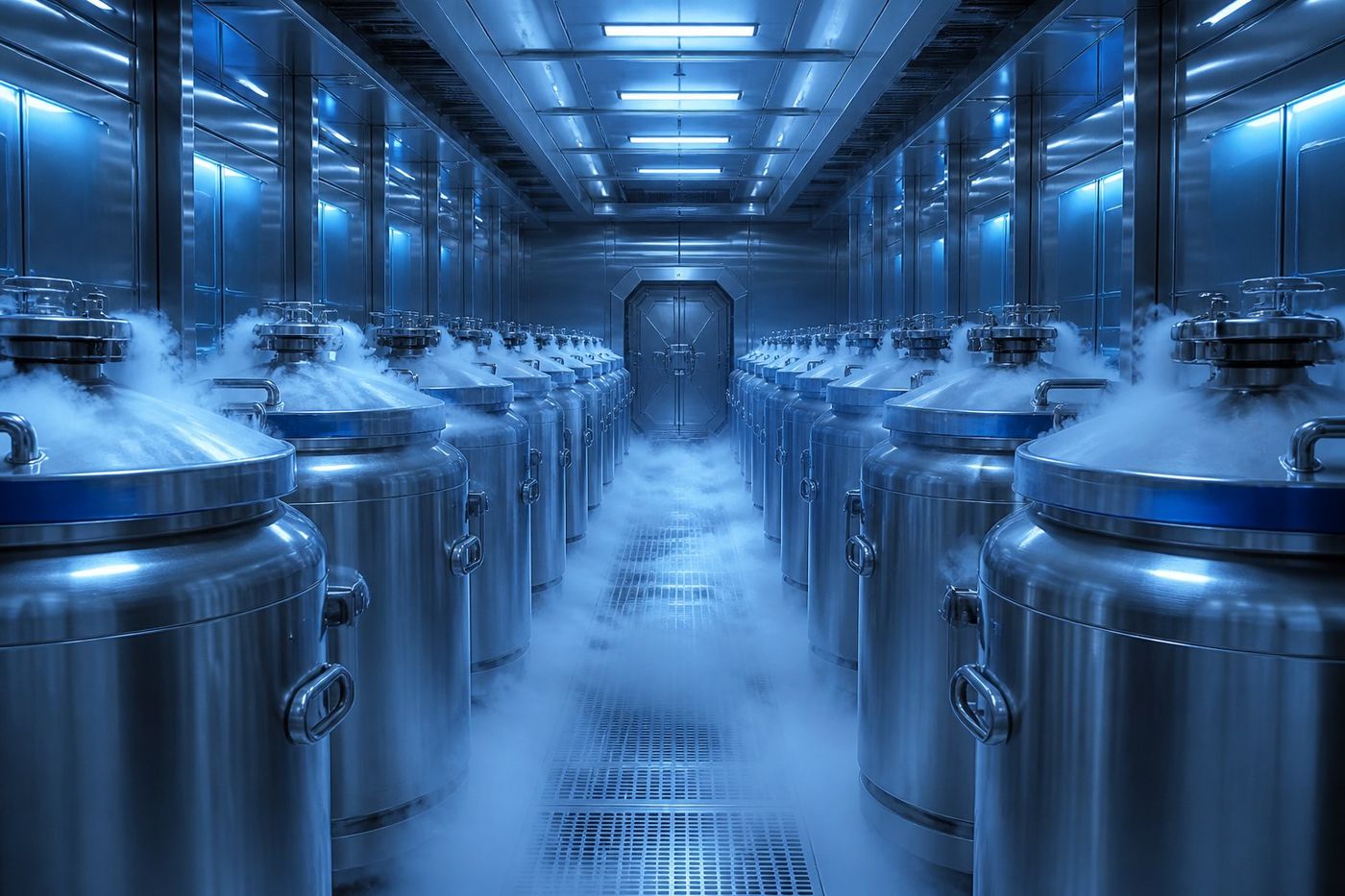
Gametes and embryos are vitrified in liquid nitrogen at −196 °C across redundant, independently powered dewars on two physical sites. Coral fragments, larvae, and tissue biopsies are banked alongside whole-genome sequences held in the digital archive. Nothing is single-copy; every accession exists in at least two locations.
−196 °C
Liquid-nitrogen vitrification across redundant dewars on two sites. Autonomous fill and breach alarms on the AquaLink mesh.
Gametes · Embryos · Tissue
Cryo-vialed reproductive material, coral fragments, and biopsy tissue, paired with sequenced reference genomes.
No single copy
Every accession exists in two or more physical locations. Loss of one site degrades coverage; it never erases a lineage.
Pedigree & genetic-diversity management
Living lines are managed against inbreeding by tracked pedigree and mean-kinship pairing — the same studbook discipline that runs the Breeding Station. Founder representation is balanced deliberately so no single lineage dominates the assurance population. Genetic-diversity retention is tracked as a standing metric: AE-MET-026.
Assurance populations
For species the surface world has abandoned, the League holds living assurance populations — breeding-stock lines large enough to ride out a wild collapse and reseed it. These are the animals standing behind the frozen vials.
Feeding restoration
The bank is not an end state. Banked diversity and living broodstock both flow outward into the Restoration & Rewilding pipeline — frozen material thawed for assisted reproduction, living lines spawned for release. A species is not saved until it swims free again.