GreenSky Breeding Station - Site Plan
The physical layout reference for the Station: how the wings are arranged, how water, people, and live stock move through them, where the public face ends and the restricted operational core begins, and how everyone gets out when the water turns against us.
Station Overview
The GreenSky Station is a coastal hub built on a strict landward-to-seaward salinity gradient and a public-to-restricted security gradient that run perpendicular to each other. Water Prep & Reservoirs sits at the geometric center — every drop of system water originates there. Freshwater halls (Cichlid Hall, Livebearer Racks, Aquatic Flora) occupy the landward wing; the brackish Invertebrate Room bridges to the seaward Reef Conservatory, which forms the public face under a 22 m daylight roof. The restricted Abyssal Holding wing is buried at the cold core below grade, the Quarantine & Triage block is deliberately offset from all production systems, and the Fleet Dock & Dispatch meets the sea at the Station's edge. Every transition between security tiers passes through a controlled threshold documented in AE-FAC-0020.
Layout Schematic (not to scale)
Stylized plan view, looking down. The blue public band fronts the sea; freshwater and plant zones occupy the landward bulk; the red Abyssal Holding wing is buried beneath the core; the dock meets the water at the bottom edge.
The Public / Restricted Split
The Station serves two masters that must never meet uncontrolled: the public it educates and the collection it protects. A single hard line — the blue boundary — separates the front-of-house from the operational core. Visitors experience the Reef Conservatory and Education atrium; they never breathe the same air as a quarantine lot or set foot on a system floor. Conversely, no live stock, no system water, and no husbandry traffic ever crosses into the public band.
Public Face
Visitor atrium, ticketing, education theatre, and the viewing galleries of the Reef Conservatory. Badge-free, escorted beyond the rail. No husbandry access, ever.
Behind the Glass
All system floors, Water Prep, Quarantine, dock transfer, and Abyssal Holding. Badge-gated by tier; the deeper and colder you go, the harder the door.
Flow of Water, People & Stock
Three flows run through the building, and they are deliberately kept from crossing where crossing would carry contamination. The plant that makes these flows possible is detailed in AE-FAC-0030.
| Flow | Origin | Path | Termination | Control Principle |
|---|---|---|---|---|
| Water | RO & seawater intake | Water Prep → species mixing reservoir → zone sump → zone tanks → filtration → return | Reclaim or controlled discharge | Each system is a closed loop; no water crosses salinity classes without re-prep. |
| People | Staff entry / visitor entry | Tier-gated thresholds, footbaths, PPE points; clean-to-dirty only | Decon on exit from Quarantine/Restricted | Movement is always toward higher tier through a controlled threshold, never around it. |
| Live Stock | Fleet Dock / breeding programs | Dock → Dispatch decon → Quarantine & Triage → (cleared) → production zone | Display, rewilding, or Abyssal Holding | No new stock reaches a production system without clearing Quarantine first. |
Dock & Vessel Access
The Fleet Dock is where the Station meets the open ocean and where the breeding and recovery programs land their stock. It is a biosecurity frontier as much as a logistics one: everything that arrives by hull is a potential vector.
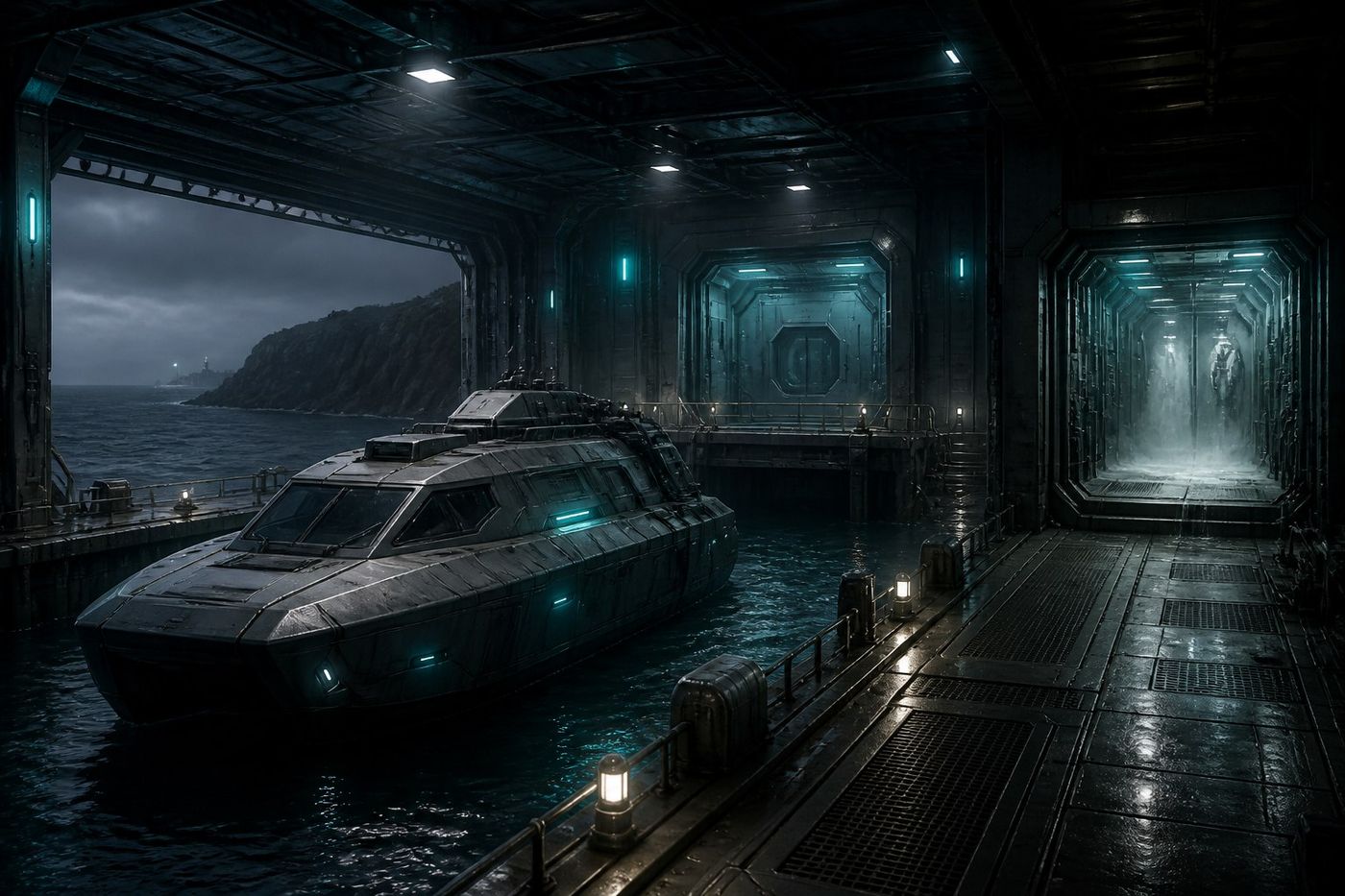
| Asset | Capacity | Function | Biosecurity Control |
|---|---|---|---|
| Berth 1 — Recovery Vessel | Up to 38 m hull | Live recovery & rewilding craft | Ballast/bilge assay before discharge |
| Berth 2 — Survey / Gyre Tender | Up to 24 m hull | Gyre Station resupply & sample runs | Hull-rinse on return from foreign waters |
| Berth 3 — Service / Haul-out | Travel-lift 80 t | Maintenance, dry transfer | In PM · decon pad active |
| Live-transfer Lock | 4 m³ transfer tank | Stock from hull → Dispatch | Sealed transfer, water never mixed with dock |
| Dispatch & Decon Bay | 2 lanes | Crate/container in-out, gear decon | Footbath, gear-dip, manifest scan |
Emergency Egress & Flood Response
The Station's worst day is a wet one. Egress is engineered so that no person is ever more than 30 m from a route that leads up and out away from a flooding bund, and so that escaping people never have to pass through a higher biosecurity tier to do it.
- Egress routes: 6 marshalled routes, all rising to the grade-level muster deck; each system floor has two independent exits.
- Restricted egress: Abyssal Holding has a dedicated one-way emergency decon-egress; using it raises a Tier-3 alarm and a breach review per AE-FAC-0020.
- Flood compartmentation: every system room is bunded to 110% of its largest vessel; bund breach isolates that room's drain and pages FAC-STR.
- Power-fail behaviour: inter-system and seawater make-up valves fail closed; egress lighting and door releases sit on the Essential Bus (AE-FAC-0030).
- Muster & accountability: badge-out at the muster deck reconciles against the access log; NEREID flags any unaccounted credential.